



Customs risk management best practices

The main challenge associated with risk management is to strike the right balance between the control of goods and trade facilitation. It is for this reason that the World Customs Organization introduced the Revised Kyoto Convention which defines the principles of risk management applied to Customs, with the objective of guiding Customs administrations in the implementation of risk management processes.
To further assist Customs in maximizing their return on investment, we have identified best practices when implementing a risk management system.
Combine the method of risk calculation
Traditionally Customs used to rely on a rule-based approach to flag high risk consignments and their judgement to further detect fraudulent behaviors. While it has helped reduce the risk of fraud and unnecessary controls, this approach on its own has its limits. We can for instance mention the risk of subjectivity as selectivity rules and controls are based on limited information and human perception rather than facts and global snapshots. It also requires resources to regularly update rules and follow-up on the fraud detection which makes this approach less dynamic.
More advanced technologies are now available to assess efficiently and automatically the risk of fraud. By relying on artificial intelligence, Customs Administrations can fully exploit their data, learn from them, detect patterns, and accurately tackle the fraud practices.
This reason we recommend combining both approaches to take your risk management to the next level. For more information read our article about the four analytical approaches to customs risk management.
Get your team on board
Your best champions are within your organization. Building understanding and sharing the vision, involving people at early stage of the project can facilitate adoption and improve results over time. Also building the right path through capacity building and will empower them in the long run.
One of the best ways to guarantee that team embraces the system is by using a software able to provide the best user experience. User-friendliness and intuitive navigation are crucial when choosing a risk management system.
Ensure data quality
Data is by far one of the most important assets for risk management. It will determine the accuracy of the predictions made by the system. Ensuring data quality is key to avoid operational inefficiency and inconsistency. Data quality is assessed based on the following criteria:
- Accuracy: the data is correct
- Completeness: all information is available
- Reliability: the data comes from trusted sources
- Timeliness: the data is up to date or just-in-time
Inability to access clean data often lead to misleading risk assessment results. The biggest risk is to focus efforts on low-risk consignments and fail to efficiently target illicit trade.
Integrate data from more sources
The purpose of risk management is to reduce information asymmetry; therefore, the more quality data are fed to the system the better. The main benefit of integrating multi-source data is that it allows to reduce inaccuracy while maximizing access to knowledge.
Additionally, this opens opportunity for cross-referencing of data and more analytics displayed in dynamic dashboards to facilitate the decision-making process at executive level.
Get the right process
Getting the best risk management system available on the market will not ensure you to eliminate the risk of fraud and increase revenue collection, if you don’t have the right process in place to integrate the system within the overall customs clearance mechanism.
In practical terms it means that it’s crucial to make sure the right steps are in place to respect the targeting results. For instance, ensuring that appropriate actions are taken when consignments are flagged by the system, and the fraud feedback is recorded are conditions of a successful application of the risk management system.
Putting in place a smart process will also foster resources optimization and productivity along with facilitating trade for all operators.
For more than 20 years, Cotecna has been working closely with Customs to perfect its Automated Risk Management System – CRMS®, our mission is to provide the most advanced solution to help Customs to always stay one step ahead of illicit trade patterns.
For more information about our CRMS® and our Customs solutions or to request a demo please contact us at governments@cotecna.com.
About Cotecna
For over 50 years, we have been supporting agriculture, food and pharma, minerals and metals, and consumer products supply chains all over the world. We provide testing, inspection, and certification services to help our clients navigate evolving regulations, ensure product compliance, and support their sustainability journey.
Latest News

30.10.2026
Beyond Carbon Footprint: A Practical Guide to More Sustainable Businesses
Explore how GHG inventories, emissions verification, Life Cycle Assessment, energy management and ESG assurance support credible business sustainability.
30.10.2026
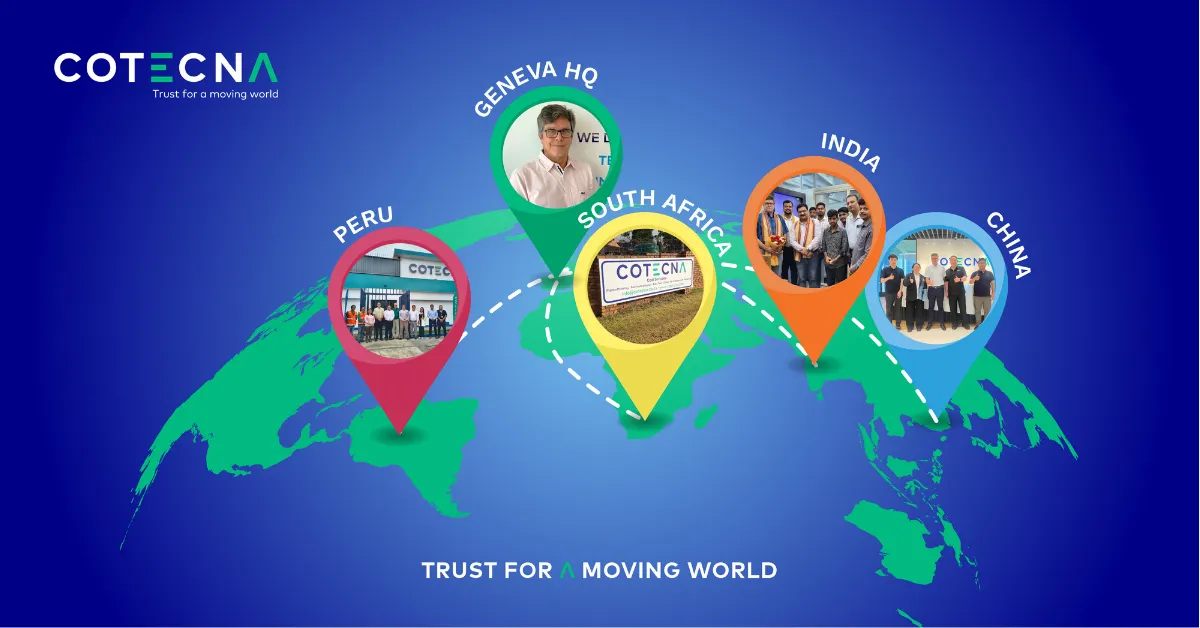
Strengthening Cotecna's Global Metals & Minerals Network Through Leadership Engagement
Mark Houchin's global visits highlight Cotecna's commitment to technical excellence and operational alignment, while focussing on strong customer partnerships worldwide.