



Customs risk management explained

While risk management is a straightforward process, when applied to Customs it involves unique circumstances. We have gathered in this article the main aspects of risk management applied to Customs to help you better understand how it works.
What is risk management applied to customs?
In the Customs environment, 100% physical inspection of all shipments is not only hardly possible, but would create considerable border congestion, and would require important means (human and financial resources). In this context and to allow a smooth movement of goods at the border, Customs Authorities are compelled by the Revised Kyoto Convention (RKC) and Trade Facilitation Agreement (TFA) to set-up a risk management process.
Yet, finding the right balance between Customs control and trade facilitation is a complex and critical exercise for Customs authorities. In addition to complying with international requirements and standards, Customs also have the important responsibility to secure border and boost revenue collection in order to drive economic growth and sponsor local development projects.
When applied to Customs, risk management is very efficient for risk evaluation and risk treatment, its main role being to identify the consignments with the highest risk level and apply the right actions (physical inspection, documentary check, fast-track…). In practice, Customs risk management is a crucial foundation to help Customs direct their efforts towards more essential tasks.
What is the best approach to Customs risk management?
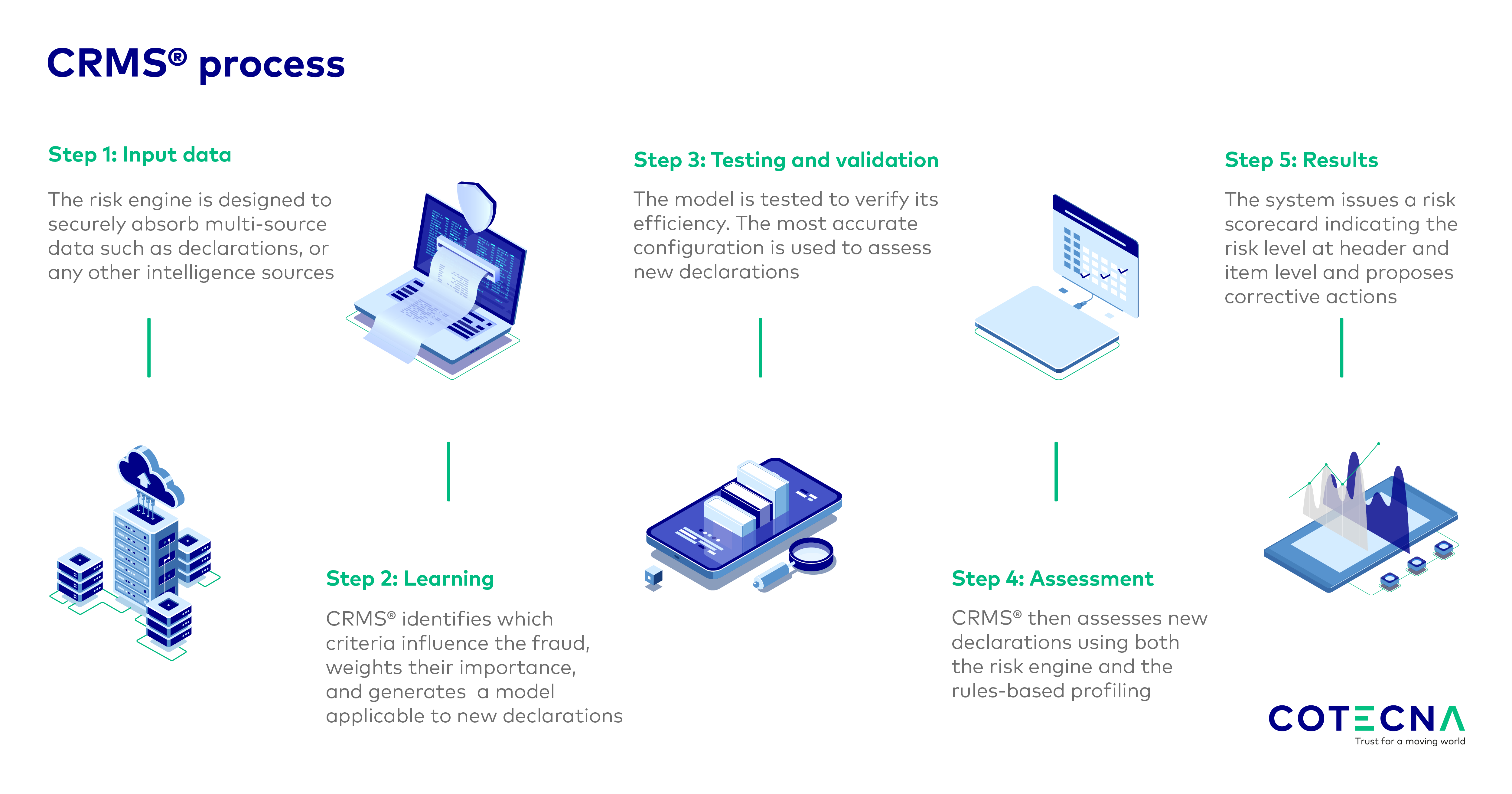
There are different approaches to customs risk management. The more traditional approach relies on Customs expertise and experience through rule-based and random to assess the need for further inspections.
However, while this approach is recommended as a basis for risk management, to magnify its impact it is imperative to fuel it with a state-of-the-art approach which rely on machine learning. Risk management systems driven by artificial intelligence have proven to be the strongest shield against security threat and the most efficient way to increase revenue collection.
By combining the two approaches, Customs can ensure the highest level of security and efficiency and take Customs operations to the next level. Both Machine Learning on customs declaration and manifest data (couple with external data whenever possible) and human intelligence are essential to reach the most accurate predictions and ensure the best performance of the system.
What are the benefits of Customs risk management?
Customs risk management can have a great impact on achieving results on an operational and strategic level. By choosing an advance solution which rely on both artificial intelligence and customs expertise, Customs can quickly enhance their performances and limit their exposure to threats.
We can identify many other benefits of risk management for Customs, it:
- Enhances revenue collection scheme through a better targeting of high-risk cargoes
- Allows a better allocation of human resources particularly in case of in trade volume growth.
- Reduces clearance time which leads to a better collaboration between the trade community and Customs.
- Enables a better efficiency in case of threats by rely on agile procedures.
- Supports modernization of customs procedures which improves reputation in the eyes of the public and of the trade community.
- Strengthens and empowers Customs authorities.
- Secures the trade environment thanks to an increased visibility over the operations.
- Favors security measures and compliance with international standards.
Overall, Customs risk management bring effective and immediate results for both Governments and economic operators.
For more than 20 years, Cotecna has been working closely with Customs to perfect its Automated Risk Management System – CRMS®, our mission is to provide the most advanced solution to help Customs to always stay one step ahead of illicit trade patterns.
For more information about our CRMS® and our Customs solutions or to request a demo please contact us at governments@cotecna.com.
About Cotecna
For over 50 years, we have been supporting agriculture, food and pharma, minerals and metals, and consumer products supply chains all over the world. We provide testing, inspection, and certification services to help our clients navigate evolving regulations, ensure product compliance, and support their sustainability journey.
Latest News

30.10.2026
Beyond Carbon Footprint: A Practical Guide to More Sustainable Businesses
Explore how GHG inventories, emissions verification, Life Cycle Assessment, energy management and ESG assurance support credible business sustainability.
30.10.2026
Strengthening Cotecna's Global Metals & Minerals Network Through Leadership Engagement
Mark Houchin's global visits highlight Cotecna's commitment to technical excellence and operational alignment, while focussing on strong customer partnerships worldwide.