



The Importance of Testing for Spices & Herbs
The popularity of herbs and spices is rising but so are the possible threats to the quality of these products and to the health of the public. Many alerts from European Countries via the Rapid Alert System for Food and Feed (RASFF) over the past years included spices and herbs, indicating the need for monitoring these commodities.
Spices are agriculturally obtained products that are often processed without further purification or heating. More than 35,000 notifications within the RASFF portal contained reports relating to contamination with microorganisms, mycotoxins, pesticides, allergens and prohibited dyes. The result is that spices & herbs rank 4th among all registered categories. The contamination of herbs and spices has far-reaching consequences, as one single batch of a product can be used in numerous follow-on products in the food chain and during food preparation at home, this way reaching a large number of people.
With this risk in mind, mapping the roots of the safety hazards could provide some much-needed clarity in how to handle them. In an article from 2018 (van Asselt et al.) the chemical hazards in spices & herbs were prioritized, see table 1.
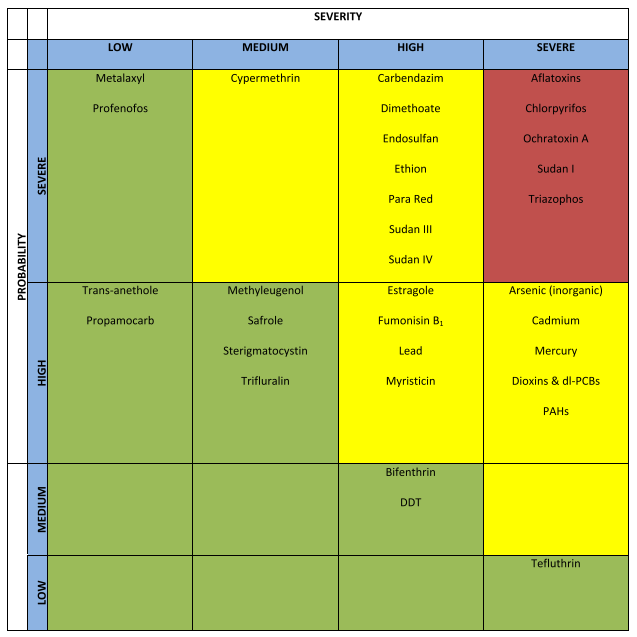
Table 1 Risk matrix of chemical hazards in spices and herbs with red: high risk, yellow: medium risk and green: low risk.
The chemical hazard most often notified is aflatoxins (Banach, Stratakou, van der Fels-Klerx, Besten, & Zwietering, 2016), which are toxic secondary metabolites produced by Aspergillus Paraciticus, a fungal toxin.
Besides natural contaminants, spices and herbs may also be subjected to deliberate contaminations. For instance, to make the spice look fresher dyes are added as colourants. Sudan dyes have been added to chilli, curry and paprika powder to intensify and maintain the natural red colour of the spices (Everstine, Spink, & Kennedy, 2013). However, due to their carcinogenic properties, Sudan compounds are not authorised as food additives in the European Union.
Besides the addition of artificial dyes, chemical residues from pesticides, any substance used to kill, repel, or control certain forms of plant or animal life, may be present. Various pesticide residues have been reported, sometimes exceeding the maximum residue level (MRL) (Ferrer Amate, Unterluggauer, Fischer, Fernandez-Alba, & Masselter, 2010).
Consumer Reports tested 126 spice products already on the market and found that almost one third, 40 to be exact, had high enough levels of arsenic, lead, and cadmium combined, on average, to pose a health concern for children when regularly consumed in typical serving sizes. Most raised concern for adults, too. (Consumer Reports, 2021).
Frequent exposure to even small amounts of lead, arsenic, cadmium, and other heavy metals is dangerous, in part because it’s difficult for the human body to break them down or excrete them. And over time, exposure to those heavy metals can harm health. In children, it can affect brain development, increasing the risk for behavioral problems and lower IQ. In adults, it can contribute to central nervous system problems, reproductive problems, and hypertension, and can damage kidney and immune function.
This brief summary clarifies the need for chemical analysis of spices and herbs for the protection of both human health and product quality.
Cotecna, a world-class international player with over 5000 employees in more than 150 offices and labs across approximately 50 countries, offers analyses on all earlier mentioned contaminants. Its trusted network of professionals and certified & accredited laboratories provide expertise on several market sectors including spices & herbs.
To learn more about our services, or to request an analysis for your business, please contact us.
About Cotecna
For over 50 years, we have been supporting agriculture, food and pharma, minerals and metals, and consumer products supply chains all over the world. We provide testing, inspection, and certification services to help our clients navigate evolving regulations, ensure product compliance, and support their sustainability journey.
Latest News

30.10.2026
Beyond Carbon Footprint: A Practical Guide to More Sustainable Businesses
Explore how GHG inventories, emissions verification, Life Cycle Assessment, energy management and ESG assurance support credible business sustainability.

30.10.2026
Strengthening Cotecna's Global Metals & Minerals Network Through Leadership Engagement
Mark Houchin's global visits highlight Cotecna's commitment to technical excellence and operational alignment, while focussing on strong customer partnerships worldwide.