



The Rising Importance of Pesticide Residue Testing in Global Commodities Trade

Rising Importance of Pesticide Residue Testing
Pesticide residue testing is quickly emerging as a critical control point for ensuring food safety, regulatory compliance, and market access.
For producers, exporters, traders, and importers of agricultural commodities, the stakes are high. A single non-compliant shipment can result in rejected cargo, financial losses, reputational damage, and even long-term exclusion from key markets.
In this landscape, comprehensive pesticide residue testing is essential to building resilient, compliant, and trusted supply chains.
Why Pesticide Residue Testing Is Gaining Strategic Importance
Pesticide residue testing is gaining strategic importance as global agriculture supply chains become more complex and regulatory scrutiny intensifies. Governments and international bodies are continuously tightening maximum residue limits (MRLs), making compliance essential for market access and trade continuity.
At the same time, consumers are increasingly demanding transparency, safety, and sustainably produced food, putting additional pressure on producers, exporters, and retailers to verify product integrity. In this context, reliable residue testing not only helps mitigate regulatory and reputational risks but also strengthens supply chain trust, supports responsible sourcing initiatives, and enables businesses to compete in high-value markets where safety and quality assurance are non-negotiable.
1. Increasingly Strict Global Pesticide Residue Regulations
Governments and regulatory bodies worldwide are tightening Maximum Residue Limits (MRLs) and expanding monitoring frameworks for pesticide residue. Markets such as the EU, US, GCC, and China enforce strict limits on pesticide residues, but often differing across jurisdictions.
- The European Union, for example, maintains some of the strictest MRL requirements globally
- Rapid updates to approved active substances create ongoing compliance challenges
- Zero tolerance policies in some markets heighten risk exposure
Market impact: Companies must continuously monitor regulatory changes and ensure shipments comply with destination specific requirements. Failure to do so can result in rejected consignments or costly recalls.
2. Greater Supply Chain Complexity
Globalisation has extended agricultural supply chains across multiple countries and intermediaries. Commodities may pass through several stages, from cultivation and processing to storage and logistics, before reaching their end markets.
At each step, there is potential for:
- Misuse or overuse of pesticides
- Cross contamination during handling or storage
- Incorrect or outdated agricultural practices
Benefit of testing: Independent verification ensures product integrity throughout the supply chain, reducing uncertainty and strengthening traceability.
3. Rising Consumer and Retailer Expectations
Consumers are increasingly aware of food safety and environmental sustainability. Retailers and brands are responding by enforcing stricter quality standards, often exceeding regulatory minimums.
- Demand for organic, low-residue, or residue-free products is growing
- Retailers are implementing private standards and supplier audits
- ESG and sustainability commitments are influencing sourcing decisions
Market impact: Suppliers must demonstrate compliance not only with regulations but also with buyer specific requirements, making high-quality residue testing a commercial necessity.
4. Trade Risk and Financial Exposure
Non-compliance with pesticide regulations has direct financial consequences:
- Shipment rejections or destruction
- Demurrage and logistics costs
- Contract penalties
- Reputational damage and loss of future business
Proactive testing helps identify risks before shipment, allowing corrective action and avoiding costly disruptions.
European Union MRL Requirements for Pesticide Residues
In the EU, pesticide residues are regulated under Regulation (EC) No 396/2005, which sets harmonised Maximum Residue Levels (MRLs) across all member states. These legally binding limits define the maximum permitted residue levels in food and feed, applying equally to domestic and imported products.
MRLs are based on Good Agricultural Practice (GAP) and supported by EFSA risk assessments to ensure consumer safety. Where no specific limit exists, a default MRL of 0.01 mg/kg applies, reflecting a precautionary approach.
Compliance is enforced through extensive monitoring and testing programs, with non-compliant products subject to rejection or recalls. As MRLs are regularly updated, businesses must continuously monitor regulatory changes. This makes reliable pesticide residue testing essential for market access and risk management.
United States MRL Requirements for Pesticide Residues
In the United States, pesticide residue limits are known as tolerances and are set by the EPA under the Federal Food, Drug, and Cosmetic Act (FFDCA). These define the maximum legal residue levels in food and feed. Tolerances are based on scientific risk assessments, with the EPA required to ensure a “reasonable certainty of no harm”, particularly for vulnerable populations.
Limits are pesticide and commodity specific, and if no tolerance exists, or levels are exceeded, the product is deemed non-compliant. Enforcement is carried out by the FDA and USDA, which monitor domestic and imported food. Tolerances are also periodically reviewed to reflect evolving science and safety standards, making residue testing essential for compliance and market access.
China MRL Requirements for Pesticide Residues
In China, pesticide residue limits are defined through national Maximum Residue Limits (MRLs) standards (GB 2763-2026), which set the maximum permitted levels of pesticide residues in food products. These limits are developed based on Good Agricultural Practice (GAP) and scientific risk assessments to ensure consumer safety.
MRLs apply to both domestically produced and imported foods, making compliance essential for market access. China’s regulatory system has expanded significantly in recent years, covering a broad range of pesticides and commodities with increasingly strict limits.
Enforcement is carried out through government monitoring and inspection programs, with non-compliant products subject to rejection or penalties. As China continues to regularly update and tighten its MRL standards, pesticide residue testing has become critical for exporters and supply chain stakeholders seeking to maintain compliance and compete in the market.
GCC MRL Requirements for Pesticide Residues
In the GCC, pesticide residue limits are defined as Maximum Residue Limits (MRLs) through GSO 382. In the UAE the standard followed for the pesticide residue is UAE.S MRL 1 and in the Kingdom of Saudi Arabia the standard is SFDA/GSO 382, which is an adoption of GSO 382.
Authorities across the GCC share a unified position on pesticide residues in food products: they treat pesticide residues as a public‑health priority, enforce strict MRL compliance, and increasingly align their regulations. Enforcement across the GCC is strict, coordinated, and built on a “zero‑tolerance” position for food products that exceed pesticide Maximum Residue Limits (MRLs).
Key Commodities at Risk
Pesticide residue risks span a wide range of agricultural commodities, including:
- Grains and cereals (wheat, maize, rice)
- Oilseeds and pulses (soybeans, lentils, chickpeas)
- Fruits and vegetables (fresh and processed)
- Spices and herbs
- Coffee and cocoa
These commodities often face tight regulatory scrutiny, especially when exported to high compliance markets.
Understanding the Pesticide Residue Testing Process
Pesticide residue testing involves detecting and quantifying trace amounts of chemical substances used in agriculture. Modern laboratories use advanced analytical techniques such as:
- GC-MS/MS (Gas Chromatography–Mass Spectrometry)
- LC-MS/MS (Liquid Chromatography–Mass Spectrometry)
- Multi-residue screening for hundreds of compounds
Testing can be conducted at several points:
- Pre-harvest (field sampling)
- Post-harvest (storage and processing stages)
- Pre-shipment verification
- Import inspection
Strategic insight: The most effective approach is not reactive testing, but integrated testing programs embedded across the supply chain.
How Pesticide Residue Testing Strengthens Supply Chains
Pesticide residue testing plays a critical role in adding strength to agricultural supply chains by ensuring compliance with global Maximum Residue Limits (MRLs) and protecting product integrity from farm to market. By identifying non-compliant residues early, it helps mitigate trade risks, prevent costly rejections, and maintain market access.
Reliable, independent testing enables producers, exporters, and buyers to make informed decisions, enhancing traceability, safeguarding consumer safety, and reinforcing confidence across the entire value chain.
Improved Compliance and Market Access
Reliable testing ensures shipments meet the regulatory requirements of destination markets, facilitating smooth customs clearance and trade continuity.
Enhanced Risk Management
Early detection of non-compliance enables corrective actions before goods are shipped, preventing costly disruptions.
Increased Buyer Confidence
Verified compliance builds trust with importers, retailers, and end users; supporting long-term commercial relationships.
Stronger Traceability and Transparency
Testing data contributes to traceability systems, enabling full visibility of product quality and safety.
Support for ESG and Sustainability Goals
Responsible pesticide use and monitoring align with broader sustainability commitments, enhancing brand reputation.
How Cotecna Helps Clients Navigate Pesticide Residue Risks
Cotecna provides end-to-end Agriculture Testing, Inspection, and Certification (TIC) solutions to help clients manage pesticide residue risks across global commodities supply chains.
1. Advanced Laboratory Testing Capabilities
Cotecna’s accredited laboratories conduct comprehensive pesticide residue analysis, covering a wide range of active substances in line with international standards.
- Multi-residue screening tailored to commodity and market requirements
- High sensitivity detection for compliance with strict MRLs
- Reliable, internationally recognised test results and reports
- Secure digital reports through Edox
Benefit: Confidence that products meet the regulatory thresholds of target markets, reducing the risk of rejection.
2. Global Sampling and Inspection Services
Accurate testing starts with representative sampling. Cotecna provides:
- On-site sampling at farms, warehouses, and ports
- Independent inspection services to verify product condition
- Pre-shipment checks aligned with contractual and regulatory requirements
Benefit: Consistent, unbiased verification across the supply chain.
3. Regulatory Expertise and Compliance Support
Navigating global pesticide regulations is complex and constantly evolving. Cotecna supports clients by:
- Interpreting MRL requirements across different markets
- Advising on compliance strategies
- Identifying potential risks early in the sourcing process
Benefit: Reduced regulatory uncertainty and improved decision making.
4. Supply Chain Integration
Cotecna works with clients to embed testing into their supply chain workflows:
- Risk-based testing programs
- Supplier monitoring and audit support
- Data driven quality control systems
Benefit: A proactive, structured approach to managing food safety risks.
5. Fast Turnaround and Global Coverage
With a global network of laboratories and offices, Cotecna ensures:
- Timely test results to support trade timelines
- Consistent service across multiple sourcing regions
- Scalable solutions for high-volume trade operations
Benefit: Operational efficiency without compromising quality or compliance.
Best Practices for Pesticide Residue Testing Compliance and Monitoring
To effectively manage pesticide residue risks, companies should adopt a proactive and structured approach:
- Implement risk-based testing programs tailored to the commodity and its origin
- Test early and frequently, not just at shipment stage
- Stay informed on evolving MRL regulations
- Work with accredited, independent TIC providers
- Integrate testing with broader quality and ESG solutions
The Future of Pesticide Residue Testing
As global trade continues to evolve, pesticide residue testing will play an even more central role in supply chain management.
Key trends include:
- Stricter global harmonisation (and divergence) of MRL standards
- Increased use of digital traceability and data integration
- Growing demand for sustainable and low-residue agricultural practices
- Expansion of rapid testing technologies for real-time decision making
For companies operating in international commodities markets, the ability to adapt to these changes will be a key competitive advantage.
Adding Strength to Agriculture Supply Chains
Pesticide residue testing is a strategic enabler of safe, compliant, and resilient global trade.
By partnering with Cotecna, clients gain:
- Trusted, independent verification
- Reduced compliance risk
- Improved market access
- Stronger supply chain transparency
In an increasingly complex and regulated environment, Cotecna helps clients add strength to their supply chains, ensuring that quality, safety, and compliance are never compromised.
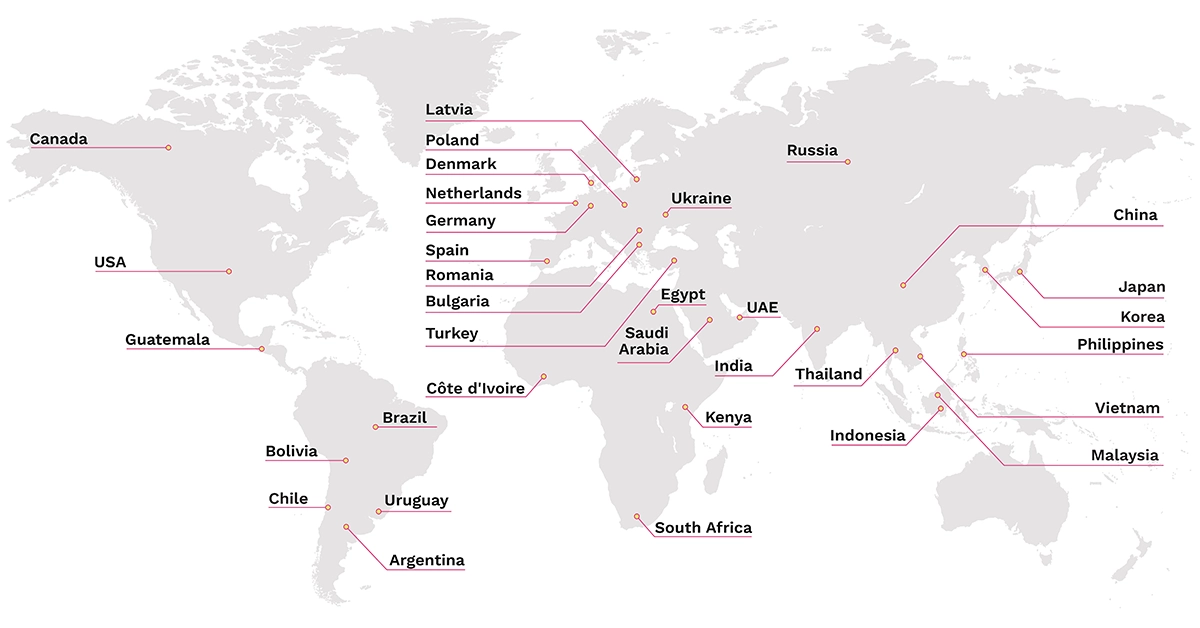
Cotecna Agriculture Global Network
Our network covers all the key trade hubs and routes globally.
Discover Cotecna Agriculture Entities
- Agronômica
- Baier Testing (Shandong Baier Testing Corp., Ltd.)
- Cotecna Netherlands, formerly Nofalab
- Fitosoil
- Geo‑Chem
- Indelab
- Neotron
- Shiva Analyticals
- Suolo e Salute
- Wimpey Laboratories
About Cotecna
For over 50 years, we have been supporting agriculture, food and pharma, minerals and metals, and consumer products supply chains all over the world. We provide testing, inspection, and certification services to help our clients navigate evolving regulations, ensure product compliance, and support their sustainability journey.
Latest News

30.10.2026
Beyond Carbon Footprint: A Practical Guide to More Sustainable Businesses
Explore how GHG inventories, emissions verification, Life Cycle Assessment, energy management and ESG assurance support credible business sustainability.

30.10.2026
Strengthening Cotecna's Global Metals & Minerals Network Through Leadership Engagement
Mark Houchin's global visits highlight Cotecna's commitment to technical excellence and operational alignment, while focussing on strong customer partnerships worldwide.